

Blog
Vitamin E Capsule for Face: Benefits, How to Use It and Who Should Skip It

A vitamin E capsule for face is a small softgel filled with vitamin E oil that you snip open and massage onto clean skin, usually at night. It’s a cheap, simple way to add moisture and antioxidant care to your routine, and that’s why it’s one of our best-selling products. But it isn’t a miracle oil, it doesn’t suit every skin type, and the vitamin E capsule you swallow is not the same as the one you put on your face.
This guide covers what vitamin E actually does for skin, how to use a capsule step by step, whether you can leave it on overnight, and who should skip it. If you already use one, such as the Animate Vitamin-E Facial Capsule, it will help you get more out of it.
What Is a Vitamin E Capsule for Face?
A facial vitamin E capsule is a single-use softgel made to be opened and applied to the skin. Each one holds a few drops of oil, so you use a fresh dose every time instead of a bottle that’s exposed to air and fingers.
Vitamin E capsules come in two different types, and mixing them up is the most common mistake:
| Facial vitamin E capsule | Oral vitamin E capsule | |
|---|---|---|
| Made for | Applying to the skin | Swallowing as a supplement |
| How you use it | Snip, squeeze, massage onto face and neck | One capsule a day with food, as labeled |
| Examples | Animate Vitamin-E Facial Capsule | Myra E 400 IU |
| Extras | Often blended with skin-friendly ingredients, such as aloe vera | Formulated for the gut, not the skin |
Always check which one you’re buying. A capsule labeled as a dietary supplement is meant to be taken by mouth.
Vitamin E Benefits for Skin: What It Can and Can’t Do
Vitamin E is a fat-soluble antioxidant, and on the skin it works mainly as a moisturizer. Cleveland Clinic describes vitamin E oil as a moisturizer that works by increasing the amount of vitamin E in your skin. Here’s what that means in practice.
Softer, More Comfortable Dry Skin
The oil sits on the skin and helps reduce water loss, so dry, tight or flaky areas feel softer. This is the benefit most people notice first, especially on the cheeks, around the nose and on the neck.
Antioxidant Support
Antioxidants help protect skin from free radicals, the unstable molecules created by sun exposure and pollution. Vitamin E adds to your skin’s own antioxidant defenses, but it doesn’t block UV rays, so it’s never a replacement for sunscreen.
Dry Lips and Rough Patches
A drop of vitamin E on dry lips, cuticles or rough elbows works like a rich balm. This is one of the safest and most useful ways to use any leftover oil from a capsule.
What It Won’t Do: Scars and Dark Spots
Vitamin E is often promoted for scars, but the evidence doesn’t support it. A 1999 study in Dermatologic Surgery found that in 90 percent of cases, topical vitamin E either had no effect on surgical scars or made them look worse, and 33 percent of patients developed a skin reaction to it. Cleveland Clinic also notes that if you use vitamin E for fine lines, it may take several months to see any effect.
For dark spots and acne marks, vitamin E is a supporting step, not the treatment. Daily sunscreen and proven brightening ingredients do the heavy lifting, and vitamin E helps keep your skin comfortable while they work.
How to Use a Vitamin E Capsule on Your Face
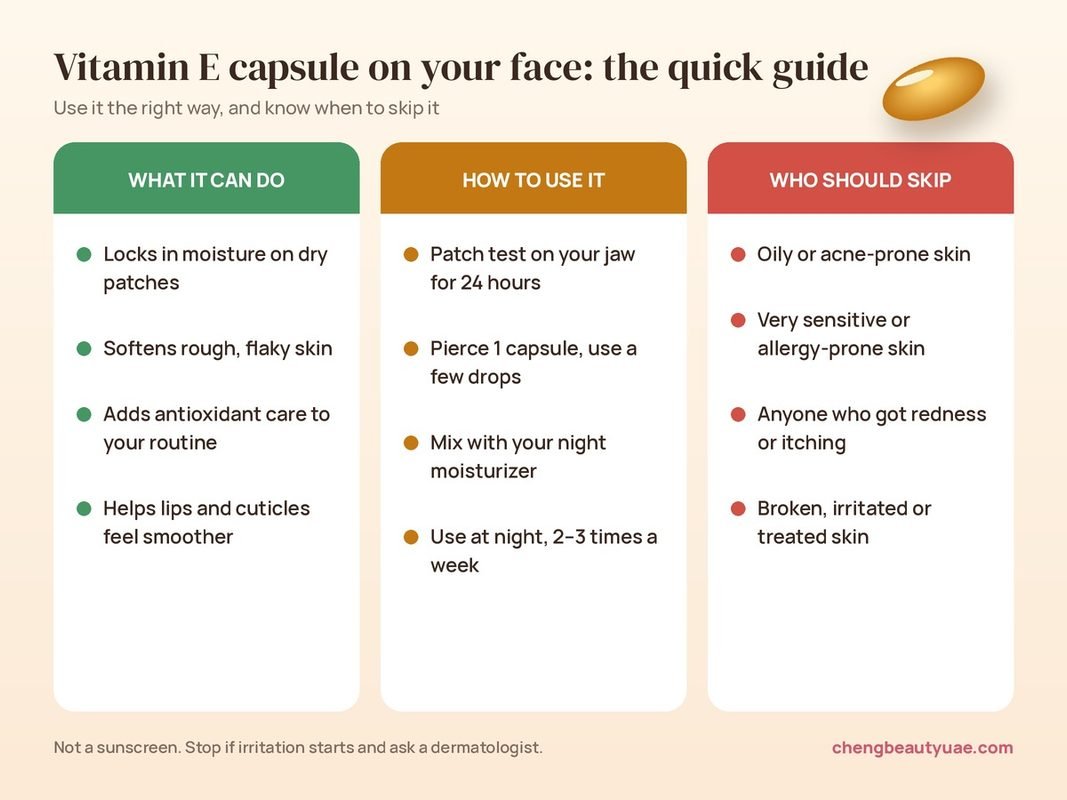
Using a vitamin E capsule for face care takes about a minute. Use it at night, when your skin isn’t exposed to sun and sweat:
- Cleanse your face and pat it dry. Apply toner if you use one.
- Snip or twist the capsule tip with clean fingers or small scissors.
- Squeeze the oil onto your fingertips. One capsule is usually enough for the face and neck.
- Massage it in gently using upward strokes, avoiding the eye area.
- Let it absorb for a few minutes, then apply your night cream on top if your skin is dry.
Do a patch test before you start. Apply a little oil along your jawline for 24 hours and check for redness, itching or bumps before using it on your whole face.
Can You Leave a Vitamin E Capsule on Your Face Overnight?
You can leave vitamin E on your face overnight if your skin is dry or normal and you’ve done a patch test. Healthline recommends applying vitamin E oil before bed because its thick texture needs time to absorb. If your skin is oily or acne-prone, use a thin layer only on dry areas, or skip overnight use altogether.
How Often Should You Use It?
Start with two or three nights a week. If your skin stays clear and comfortable after two weeks, dry skin can move to nightly use. Oily and combination skin usually does best with one or two nights a week, which is also what Healthline suggests to avoid clogged pores.
Who Should Skip Vitamin E Capsules (or Go Slowly)
A vitamin E capsule for face use is gentle for many people, but it isn’t right for everyone. Be careful, or skip it, if:
- You have acne-prone or very oily skin. Vitamin E is thick, and Healthline notes that it can clog pores and aggravate breakouts in people whose pores clog easily.
- You’ve reacted to vitamin E before. Allergic and irritant reactions do happen, as the scar study above showed. Stop using it if you get redness, itching, burning or a rash.
- You have broken or freshly treated skin, such as after a peel, laser or a new cut. Let it heal first.
- You’re pregnant or breastfeeding. Cleveland Clinic advises telling your doctor before using vitamin E skin products.
- You want to use it around your eyes. Keep it out of the eyes themselves, and use only a tiny amount on the outer under-eye area.
If you have frequent breakouts, a light, water-based moisturizer is usually a better daily choice than any facial oil.
Vitamin E Capsule vs Vitamin E Oil for Face
A vitamin E capsule and a bottle of vitamin E oil contain the same kind of ingredient, but they’re packed differently. Capsules give you a fresh, sealed dose each time and are easy to carry. Bottles are cheaper per drop but are opened again and again, which exposes the oil to air.
Pure vitamin E oil is also very thick. Healthline suggests mixing one or two drops of pure vitamin E oil with about 10 drops of a lighter carrier oil before applying it. Facial capsules that are already blended for the skin, such as vitamin E with aloe vera, are easier to spread straight from the capsule.
Can You Put Myra E on Your Face?
Myra E is an oral vitamin E supplement, so it’s made to be swallowed, not applied to the skin. The Myra E 400 IU capsules we stock are meant to be taken one a day with a meal, as the label directs.
Some people break oral capsules onto their face anyway. It isn’t what the product is designed or labeled for, and a facial capsule costs less per use. If you want vitamin E for your skin from the outside, use a facial capsule. If you want it as a daily supplement, take an oral one as directed and ask your doctor first if you take other medicines.
Using Vitamin E in the UAE Climate
UAE weather is hard on skin in two opposite ways. Air conditioning dries your skin out indoors, while heat and humidity outside make heavy products feel greasy and can clog pores.
That’s why a vitamin E capsule for face care works best here as a night step, applied to dry areas, not as a daytime layer under the sun. In the morning, use a light moisturizer and a broad-spectrum sunscreen, because no amount of vitamin E protects against UV. You can compare light options in our sunscreen collection.
If your skin has changed since moving to the UAE, our guide on skincare that actually works in the UAE explains what to adjust.
Vitamin E Capsule Price in the UAE
Facial vitamin E capsules are one of the most affordable skincare steps you can add. The Animate Vitamin-E Facial Capsule is AED 12.75 for 60 capsules at Cheng Beauty UAE, which works out to about AED 0.21 per use. Myra E 400 IU oral capsules are AED 40.50 for 30.
If dark spots are your main concern, pair vitamin E with a targeted brightening serum, such as the Dr. Meinaier Alpha Arbutin Face & Body Serum, and wear sunscreen every day.
You can find vitamin E capsules, serums and sunscreens at Cheng Beauty UAE, where we sell genuine, sealed products with delivery across the Emirates, usually within one to two days. Delivery is AED 15 in standard areas, free on orders over AED 250, and cash on delivery is available.
Frequently Asked Questions
Can I apply a vitamin E capsule directly on my face?
You can apply a facial vitamin E capsule directly on clean skin. Snip the tip, squeeze the oil onto your fingertips and massage it in, avoiding your eyes. Patch test first, and use oral supplement capsules only as directed on their label.
What are the benefits of vitamin E for the face?
Vitamin E mainly moisturizes the face and adds antioxidant support, which helps dry, tight skin feel softer. It’s a supporting step for dark spots and fine lines, not a proven treatment for them.
Can I leave vitamin E on my face overnight?
You can leave vitamin E on your face overnight if your skin is dry or normal and you’ve done a patch test. Oily or acne-prone skin should use a thin layer on dry areas only, or skip overnight use.
How often should I use a vitamin E capsule on my face?
Use a vitamin E capsule on your face two or three nights a week to start. Dry skin can move to nightly use if it stays clear, while oily skin usually does best with one or two nights a week.
Is vitamin E good for oily or acne-prone skin?
Vitamin E isn’t usually the best choice for oily or acne-prone skin, because its thick texture can clog pores and worsen breakouts. If you want to try it, patch test first and apply it only to dry patches.
Does vitamin E remove scars and dark spots?
Vitamin E doesn’t reliably remove scars or dark spots. A 1999 study found topical vitamin E had no effect on, or worsened, surgical scars in 90 percent of cases. Sunscreen and brightening ingredients work better for dark spots.
Can I put Myra E on my face?
Myra E is an oral supplement made to be swallowed, not applied to the skin. For your face, a facial vitamin E capsule is designed for topical use and costs less per application.
Can I use vitamin E on my lips?
You can use vitamin E on your lips as a rich balm for dryness. Apply a drop at night, and stop if you notice any itching or swelling.